
Seminars@DEM - Tarek Hamel (Université Côte d'Azur)
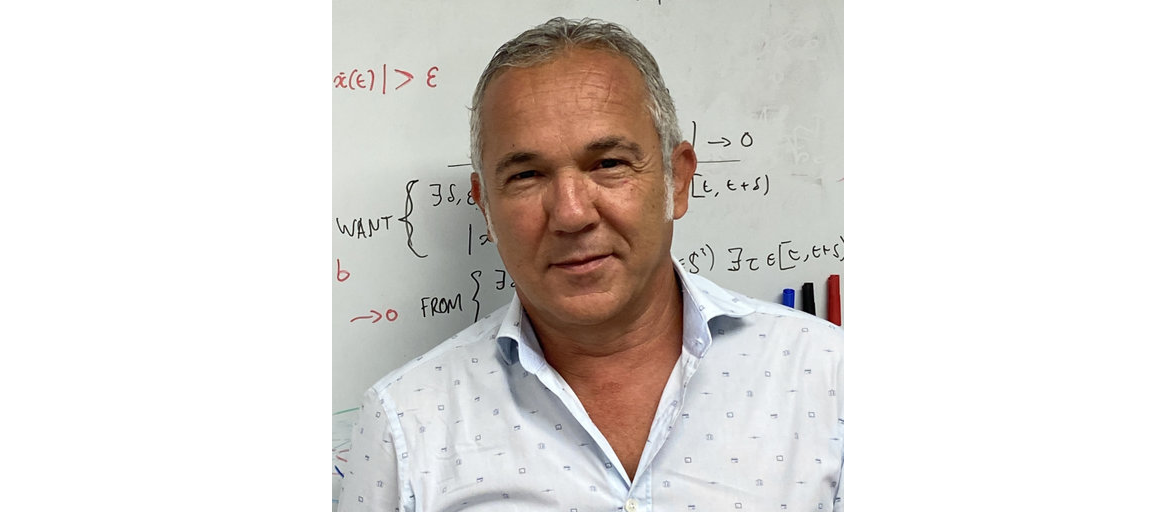
"Synchronous Observer Design for Inertial Navigation Systems with Almost-Global Convergence" - September 24, 2026, Thursday, 3:00 pm, Pavilhão de Informática III, amphitheatre FA3
Date: September 24, 2026, Thursday
Time: 3:00 pm
Place: Pavilhão de Informática III, amphitheatre FA3
• Speaker: Tarek Hamel (I3S-CNRS - Laboratoire d'Informatique, Signaux et Systèmes de Sophia Antipolis, Centre National de la Recherche Scientifique, Université Côte d'Azur, France)
• Title: "Synchronous Observer Design for Inertial Navigation Systems with Almost-Global Convergence"
(Seminar delivered in English Language)
• Abstract:
An Inertial Navigation System (INS) is a system that integrates acceleration and angular velocity readings from an Inertial Measurement Unit (IMU), along with other sensors such as Global Navigation Satellite Systems (GNSS) position, GNSS velocity, and magnetometer, to estimate the attitude, velocity, and position of a vehicle.
This talk will show that the INS problem can be analyzed using the automorphism group of the special Euclidean group when only the GNSS velocity is measured (or the automorphism group of the extended special Euclidean group SE_2(3) – a group called the extended similarity group SIM_2(3) when the GNSS position is available).
By exploiting this novel geometric framework, a synchronous observer architecture is proposed, that is, an observer architecture for which the observer error is stationary if the correction terms are set to zero. In turn, this enables the derivation of a modular, or plug-and-play, observer design for INS that allows different sensors to be added or removed depending on what is available in the vehicle sensor suite. Furthermore, the almost-global asymptotic and local exponential stability of the error dynamics is proven for the common scenario of at least an IMU and GNSS velocity or position.
A simulation with extreme initial error demonstrates the almost global robustness of the system. Real-world capability is demonstrated on data from a fixed-wing UAV, and the solution is compared to the state-of-the-art ArduPilot INS.
• Short Biographic Note:
Tarek HAMEL has been a Professor at the Université Côte d'Azur since 2003. He received his Ph.D. in Robotics from the Université de Technologie de Compiègne (UTC), France, in 1996. After two years as a research assistant at UTC, he joined the Centre d'Études de Mécanique d'Île-de-France in 1997 as an Associate Professor. His research interests encompass nonlinear control theory, estimation, and vision-based control, with a particular focus on applications to unmanned robotic systems.
Tarek Hamel is an IEEE Fellow and a senior member of the Institut Universitaire de France. He has served as an Associate Editor for IEEE Transactions on Robotics, IEEE Transactions on Control Systems Technology, and Control Engineering Practice.
This is another Seminar of the "Seminars@DEM" cycle.